Things to see and do in Saint-Étienne

Design, art, sport, history and culture, as well as a location in the Massif Central – Saint-Étienne has lots to offer visitors. See it all with LeShuttle.
Why visit Saint-Étienne?
Nestled in the mountainous Massif Central and known for its industrial heritage (which has been turned into several fascinating museums), Saint-Étienne has blossomed into a UNESCO Creative City. Whether it is design, art, history or culture you are looking for in a city, Saint-Étienne delivers it – along with plenty for football and sports lovers. On the way there you’ll also be able to savour stunning landscapes, incredible architecture and tempting vineyards.
 Place Jean-Jaurès
Where is Saint-Étienne?
Saint-Étienne is located in the Auvergne-Rhône-Alpes region of east central France, just over an hour’s drive south of Lyon.
A brief history of Saint-Étienne
The city grew up around a church dedicated to Saint Stephen and a Cistercian abbey. During the 16th century it became known as a town that produced both weaponry and ribbons.
Saint-Étienne rose to prominence in the 19th century as a major centre for coal mining. Its population exploded after 1850, and heavy industry played an important role in the city’s growth. Saint-Étienne became a centre for bicycle manufacturing. It is now a world leader in design and is part of the UNESCO Creative Cities network.
Top tourist attractions in Saint-Étienne
The state-of-the-art Planétarium
Built as part of the regeneration of a former industrial site, the Planétarium de Saint-Étienne is a fun thing to do for the whole family. There is a projection room where you can watch 3D presentations on the sky and deep space, and a simulator to understand more about far distant galaxies, planets and constellations. The planetarium, unmistakeable because of its distinctive dome, is on Rue Pierre and Dominique Ponchardier and is open seven days a week during the summer, but closes for an hour from 12.30-1.30pm Monday-Friday.
 The Planetarium of Saint-Étienne in the grounds of a former industrial site
Musée d’Art et d’Industrie
This is a museum that reflects the city’s three main areas of manufacturing – armaments, bicycles and ribbon-making. The permanent exhibitions tell the story of Saint-Étienne through these vastly contrasting products, exploring the technical aspects of their production, with collections that feature original antique bicycles, firearms and silks. The Musée d’Art et d’Industrie is open 10am-6pm every day except Mondays and is located on Place Louis Comte in the city centre.
Musée de la Mine
For anyone interested in what life was like for a coal miner in Saint-Étienne, the Mining Museum is a must-visit experience. The museum is housed at an old mine shaft close to the city centre, and visitors can take the same daily journey made by generations of miners, stepping into the cage and taking the lift deep below ground, and then the train to the coal face itself. You can also tour the restored washrooms, lamproom and power room, and the exhibition rooms in which the history of the mines of Saint-Étienne unfold before your eyes.
Stade Geoffroy Guichard
As with many cities, Saint-Étienne is known worldwide for its football team. AS Saint-Étienne is one of France’s most famous clubs, having won the Ligue 1 title ten times in its history. Saint-Étienne’s last league title was in the early 1980s when the club was captained by one of the all-time great French players, Michel Platini. The team are known as Les Verts (‘the Greens’) and they play at the Stade Geoffroy Guichard. The stadium houses a museum about the history of AS Saint-Étienne, and runs regular stadium tours.
 Stade Geoffroy Guichard, the home of AS Saint-Étienne. Credit: Stade Geoffroy Guichard, by @ville de St Etienne, CC BY-SA 4.0, via Wikimedia Commons
Place Jean-Jaurès and Cathedral
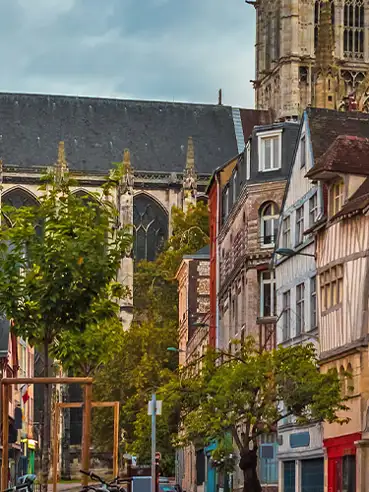
Place Jean-Jaurès is the city’s main square and is dominated by the neo-Gothic cathedral, completed in the early 20th century. The square is leafy and lined with bars, restaurants and cafés. Here is the place to sit outside and while away a few hours over a leisurely lunch and watch the world go by. Sports fans make a beeline here to soak up the atmosphere before a big game at the Stade Geoffroy Guichard.
Grand’Église
The oldest church in Saint-Étienne, the Grand’Église was built between 1450 and 1480 in the Gothic style. It suffered in the Wars of Religion and the French Revolution, but some fine works of art remain, such as the ‘Veu de Ville’ painting, and Guillaume Fontaine’s 16th-century wood sculpture of the ‘Mise au tombeau’.
Cité du Design
La Cité du Design is at the heart of Saint-Étienne’s status as a UNESCO City of Design. Located on the site of a disused armaments factory, the Cité incorporates the school of art and design, an architectural school and a broadcasting centre. It hosts an International Design Biennial featuring exhibitions, conferences and publications highlighting design culture from around the world.
 The entrance to Cité du Design, Saint-Étienne
Outdoor activities and hiking near Saint-Étienne
Crêt de la Perdrix
Saint-Étienne is in the Massif Central, and the peaks are not too far away from the city. One easy walk you can do is the Crêt de la Perdrix, or Crest of the Partridge, a hike along the ridge of the Mont Pilat. It takes around 35-40 minutes to drive to the start of the short summit walk from Saint-Étienne, but you can do a longer trek (around 7km) from the car park near the Col de l’Olleillon. It is not a challenging walk and there is an observation deck at the summit, offering amazing views of the Alps and Rhone Valley.
Mont Pilat Regional Natural Park
The Mont Pilat mountain range is designated a French natural park, covering 65,000 hectares in the eastern Massif Central. Like national parks in the UK, this status protects wildlife and the landscape from development. As well as hiking, the park offers superb opportunities for mountain biking, bird watching and seeing a rich array of wildlife. Keep your eyes peeled for wild boar or golden eagles as you explore the high ground and valleys.
 Sunrise from the summit of Crêt de la Perdrix
Further afield in the Massif Central
The Massif Central is one of France’s great wildernesses, so take the opportunity to explore its soaring peaks, breathtaking canyons and remote lakes. The mountains are challenging enough that the Tour de France makes regular visits to the area. The Chaîne des Puys is perhaps the highlight: a range of extinct volcanoes including Puy de Dôme and Puy de Sancy, the highest peak in the region at 1,885m.
Events and festivals in Saint-Étienne
The International Design Biennial is the biggest event on the Saint-Étienne cultural calendar. It takes place every two years in the spring and early summer and attracts designers from around the world, as well as contributions from design students and academics. Exhibitions are staged at the Cité du Design and other venues around the city. Other notable events are the Rhino Jazz Festival, held in Saint-Étienne and nearby Saint-Chamond in September and October, and Festival Nouveaux Rêves, a film festival held each April.
Driving to Saint-Étienne from Calais
You can drive to Saint-Étienne from the LeShuttle terminal in Calais in around 8 ½ hours. The quickest route from Calais is by taking the A26 via Reims and Troyes, where you pick up the A5 and A31 and then the A6 via Lyon. Another option is to drive towards Paris on the A16, before taking the A10 and A71 motorways via Orléans and Clermont-Ferrand.
You will pay tolls on both these routes.
Plan Your Visit to Saint-Étienne with LeShuttle
Saint-Étienne is a sporty city, but there are plenty of other things to do while you are there. It all starts with a 35 minute crossing from Folkestone via LeShuttle.
FAQs
What are the top attractions in Saint-Étienne?
The Planétarium, the Musée d’Art et d’Industrie and the Mining Museum are some of the top attractions in Saint-Étienne.
Is Saint Étienne good for design lovers?
Yes, Saint Étienne is a UNESCO Creative City, recognised for its excellence in design. Cité du Design is the city’s design hub, and hosts the International Design Biennial.
What museums can you visit in Saint Étienne?
The city has turned its industrial history into some fascinating museums. These include the Mining Museum and the Museum of Art and Industry.
How do you get to Saint-Étienne from Lyon?
Driving from Lyon to Saint-Étienne takes just over an hour, on the A7 and A47 roads.
What can you do in Saint-Étienne with kids?
The Planétarium is the number one attraction for children in Saint-Étienne. They will learn about the planets, the solar system and deep space through interactive displays and 3D presentations.
Explore traveller guides