French toll roads explained

Our complete guide to toll roads in France, how to pay at toll booths and how much the tolls cost.
If you’ve never driven in France before, one of the first things to be aware of is the need to pay road tolls.
Where are tolls used in France?
 Get in the right lane at the toll booth
France operates a countrywide system of motorway toll charges. This is because drivers in France do not pay an annual road tax – toll charges help finance road maintenance.
Tolls apply on most autoroutes (motorways in France have an A classification), but not all. For any journey of reasonable length in France, using the most direct or the fastest route, you will expect to have to pay tolls of some kind. But it is possible to drive long distances in France without tolls, as long as you plan in advance.
Tolls are not charged on ‘national’ (N) or ‘departmental’ roads (D), and you can avoid toll roads by using the ‘avoid tolls’ option on mapping apps. This will extend your journey time, and on long journeys may involve significant diversions. You will have to weigh up the money saved on tolls by the extra fuel or battery you will be using.
Non-motorway roads are indicated by green signage, as opposed to blue for autoroutes.
How much do tolls cost?
The toll charges will vary, depending on the length of your journey. In 2025 toll charges were increased throughout France. Obviously the longer you drive the higher the toll charge will be, and this may be something to factor while planning your trip. For example, driving from Calais to Marseille in the south of France, your toll charge will be around €105 each way. The single trip toll charge from Calais to central Paris is around €25. Toll calculators will give you information about the cost of fuel for your journey too.
Here are some example journeys with approximate toll charges from the LeShuttle terminal in Calais, for an idea of how the toll charges increase with distance.
| Journey | Distance | Driving time | Toll charge* |
| Calais to Rouen | 129 miles (208 km) | 2 hours 15 mins | €10 each way |
| Calais to Paris | 177 miles (285 km) | 3 hours 30 mins | €25 each way |
| Calais to Dijon | 354 miles (570 km) | 5 hours 30 mins | €57 each way |
| Calais to Bordeaux | 538 miles (867 km) | 8 hours 30 mins | €92 each way |
| Calais to Nice | 764 miles (1230 km) | 12 hours 30 mins | €126 each way |
*Toll charges are approximate (last update: July 2026)
How will I know if a toll booth is approaching?
 You’ll get plenty of warning that a toll plaza is approaching. Marc Mongenet, CC BY-SA 4.0, via Wikimedia Commons
Signs will warn that a toll booth (péage) is coming up, with the distance clearly indicated. The first signs appear 1-2 miles before the toll booth. You will also get advance warning about sections of tolled road. The signs will show if the booth is manned, and what payment methods it accepts.
When you join a tolled autoroute in France, you’ll collect a ticket at the entry toll plaza. At the exit toll barrier, you insert this ticket into the machine, and the amount you need to pay will be displayed.
How do I pay tolls in France?
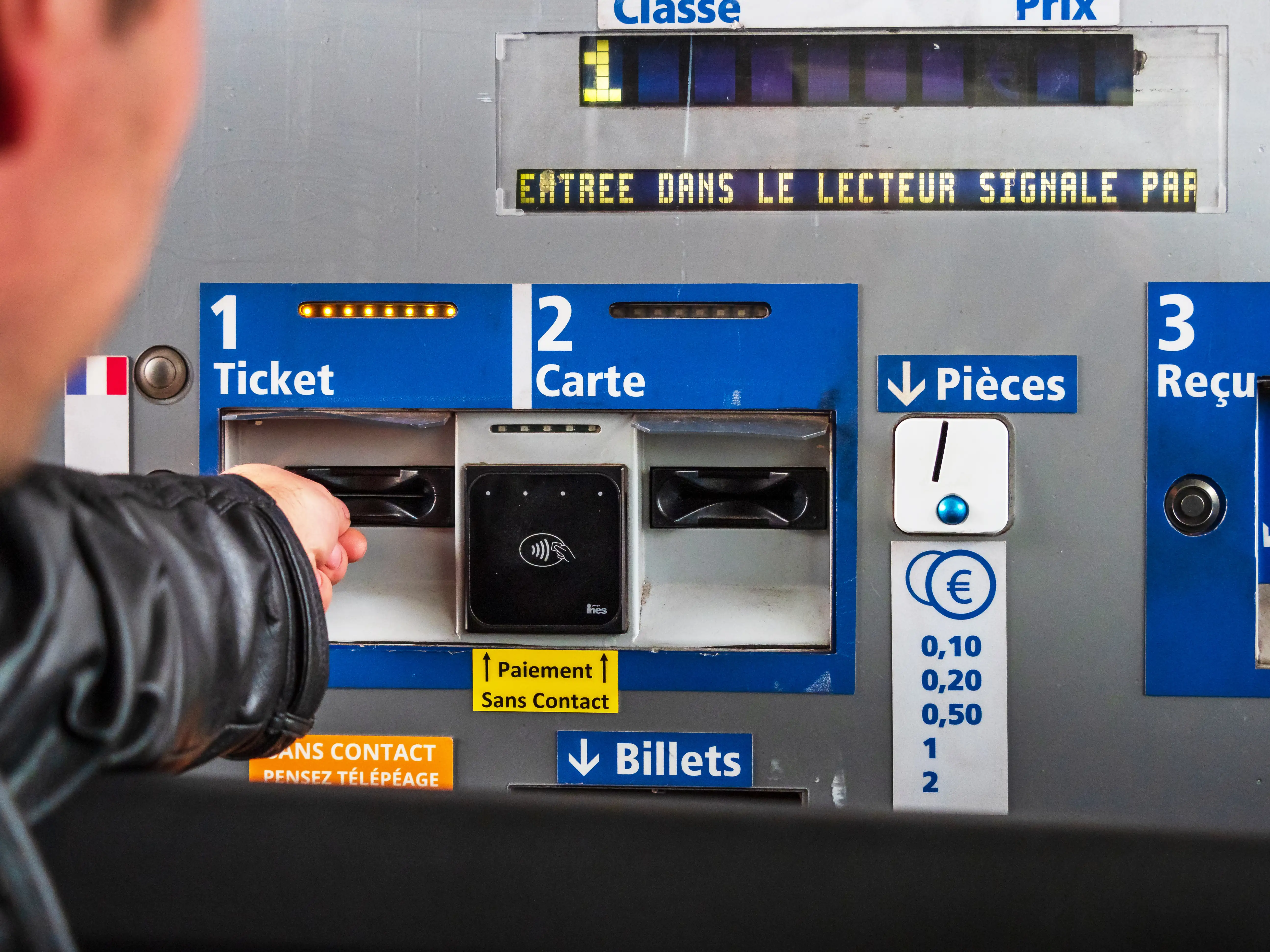 If you don’t have a toll tag, you pay by card or cash
Toll booths accept payments via card, cash, or a toll tag. You will have to get in the right lane for the method of payment you are going to use. If you are paying by card or cash, you will have to stop at the booth.
Paying by toll tags, like Emovis, mean that you don’t have to come to a complete stop at the booth. Display the tag on your windscreen, and drive slowly enough for it to be scanned by the booth camera. You will need to be in the orange ‘t’ lane (télépéage) if you have a toll tag. Some ‘t lanes’ allow you to drive at up to 30 km/h through the barrier, but these will be clearly signed.
Increasingly there are some autoroutes in France which operate a frictionless, automated toll system. First introduced in 2023, these are called ‘Flux Libre’ (free flowing), and you pay either in advance or within 72 hours. Registration plates are read at these tolled sections and if payment is not made fines are automatically issued to the registered owner of the vehicle. For example, the A13 between Rouen and Paris is now ‘flux libre’.
What are the benefits of a toll tag?
Toll tags have a number of benefits. You can skip the queues in the card and cash payment lanes, and while there is no difference in how much you pay, the charges will be processed in GBP if you’re travelling from the UK. The charges will be taken from your account automatically. You don’t have to plan ahead, think about having cash or the right credit card – just head for the ‘t’ lane. You can sometimes drive up to 30 km/h through the télépéage lane.
Exclusive Emovis toll tag offer with LeShuttle
Emovis is the main toll tag provider for UK-based drivers, and LeShuttle has partnered with Emovis on a fantastic offer. LeShuttle customers can save £10 on the application fee for an Emovis toll tag, plus:
- 50% saving on the annual fee, only €5 (normally €10) from the second year of subscription
- €20* refundable security deposit on the tag
- €7* active usage fee - only for the months in which the tag is used and capped at €14 in any subscription year
How do I know which company to pay?
This is a fair question, because different private companies operate the toll booths on specific motorways in France. These include Sanef, Vinci Autoroutes, SAPN, APRR and Aliae. On the ‘Flux Libre’ routes you will need to check the signage as you pass through the toll plaza to find out which company to contact. Visit the toll operator’s website to pay, or check before you travel and pay in advance.
How much will I be fined if I don’t pay?
UK drivers can still be fined if they don’t pay the tolls at the frictionless ‘Flux Libre’ tolls. These have to be paid within 72 hours. If payment isn’t made drivers are sent a letter to their registered address with a fixed penalty notice. If not paid within 15 days, this rises to €90, plus the toll charge. After two months the fine increases to €375.
Keep up to date with driving requirements in France
Tolls are one of the key things to be aware of when driving in France. See our other guides for more rules of the road:
Frequently asked questions
What happens if I miss a toll booth?
You can’t miss a toll booth – you will have to stop your vehicle at the traditional non-automated barriers, and pay. On free flowing toll roads, make sure you pay within 72 hours to avoid a fine.
How do I know if I owe tolls in France?
If you have driven through one of the free flowing ‘Flux Libre’ toll booths, you will have 72 hours to pay.
What is the fine for not paying tolls in France?
You have 72 hours to pay the toll charge on ‘Flux Libre’ roads, but if you don’t pay in that time you will receive a fixed penalty notice. This will be sent to your address in the UK. This fine can be reduced if paid promptly.
Can you drive through France without tolls?
Yes you can, but it will take some planning and significantly extend your journey time, You will also use more fuel.
Which other European countries have nationwide tolls?
Spain, Italy, Portugal, Croatia and Greece are the other nations in Europe to have a nationwide system of motorway tolls.
Explore traveller guides