
Visit the WW2 museum at Blockhaus d’Éperlecques

Velvet, CC BY-SA 4.0, via Wikimedia Commons
Encounter one of the largest wartime bunkers in northern France, built by the Nazis to be a launch pad for V-2 rockets.
Explore the largest World War II bunker in Northern France, and discover more about its dark history.
What is the Blockhaus d’Éperlecques?
Blockhaus d’Éperlecques is a former Nazi wartime bunker built in a forest near Saint-Omer, which was used with the intention of assembling and launching V-2 rocket missiles. The bunker was heavily bombed during Operation Crossbow in 1943-44 and eventually abandoned, but has been open to the public as a museum since 1973.
There are thousands of World War II bunkers in Northern France, mainly on the coastline as part of the ‘Atlantic Wall’ of defensive fortifications installed by the Nazis during the occupation. Blockhaus d’Éperlecques is dramatically different. It is on a much larger scale, and its purpose and location was meant to be concealed from the Allies. It is similar in size to La Coupole, just 25 minutes drive away. Both were built to manufacture, store and launch V-2 rockets, ballistic missiles that were used in devastating bomb attacks on London and other European cities.
No V-2s were ever launched from Blockhaus d’Éperlecques, but the site remains a powerful place to visit.
 Rockets on their launch pads give a powerful reminder of why the bunker was built (Image credit: Alain.Darles, CC BY-SA 3.0, via Wikimedia Commons)
Blockhaus d’Éperlecques at a glance
| Location | Hauts-de-France, 35 minutes drive from Calais |
| When is it open? | April to October |
| What can you see? | Bunker (inside and perimeter), woodland trail, military hardware, small gift shop in ticket office |
| How much are tickets? | €11.50 for adults €6.50 for children |
| How long do you need? | 1 hour 45 minutes |
| Is the museum family-friendly? | Yes, but may not be suitable for very young children |
What to see at the Blockhaus d’Éperlecques museum
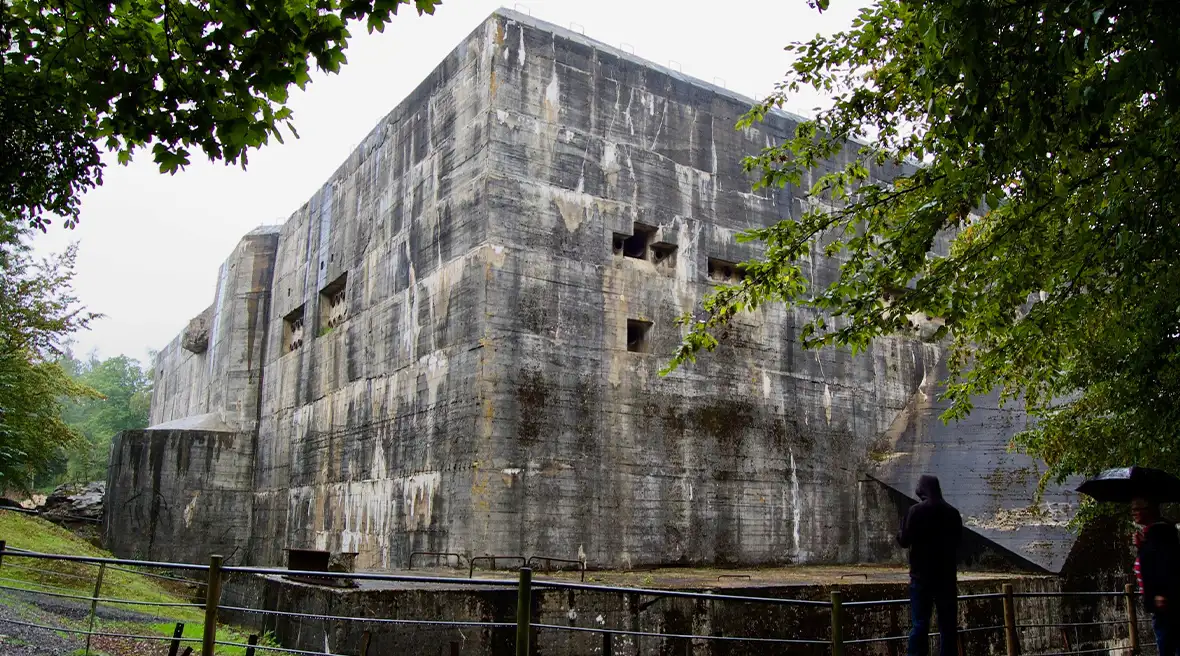 As huge it is, the bunker was intended to be much bigger
Explore the massive wartime bunker
The 7-storey concrete bunker is huge – with a footprint about the size of one football pitch – but it was planned to be around three times bigger. Construction began in March 1943, but the Allies bombed it repeatedly, before the site was captured in September 1944. It was left ‘a desolate heap of concrete, steel, props and planking’.
There is a walkway around the perimeter of the bunker, where you can see how badly damaged the bunker was by those bombing raids, which happened while forced labourers, many from concentration camps, were still working on its construction. Audio guides allow you to hear the sound of planes flying overhead.
See the V-1 flying bomb and V-2 rocket replicas
Stepping inside the main atrium is an eerie experience. The museum is well curated, and tells how Hitler’s plans for his ‘wonder weapon’ progressed quickly. A replica V-2 stands upright, nearly as tall as the bunker, and a replica of a ‘Tallboy’ bomb hangs down from the ceiling – the type that devastated the bunker in 1944 during Operation Crossbow. Sound points provide information about the bunker as you walk through its ghostly concrete chambers.
Outside you’ll see a launch pad with a V-1 rocket replica, and an upright V-2. Tanks, trucks, guns and other military hardware are dotted around the site. Outside, the bunker has very much been left as it was when it was abandoned.
Follow the woodland trail through the site
 On your way to the bunker you experience the sounds of a journey to a concentration camp (Image credit: Nilfanion, CC BY-SA 4.0, via Wikimedia Commons)
Before you reach the bunker itself, you walk through woods on a trail that acts like an immersive war experience. Visitors are asked to board a railway cattle truck, while audio plays the sounds of panicking people, babies crying and dogs barking. You’re forced to imagine what it was like being transported to Buchenwald concentration camp. It is part of the museum’s educational mission. Elsewhere there are guard posts, road signs and bombs sticking out of the ground.
Discover the site's wartime history through films and displays
Inside the museum a short film is played, telling the story of the bunker and the V-2 program that led to its construction. Displays on the walls give a timeline of the bunker’s history, and how it would have looked if it had been fully constructed.
What else is there to visit on a day trip to Blockhaus d’Éperlecques?
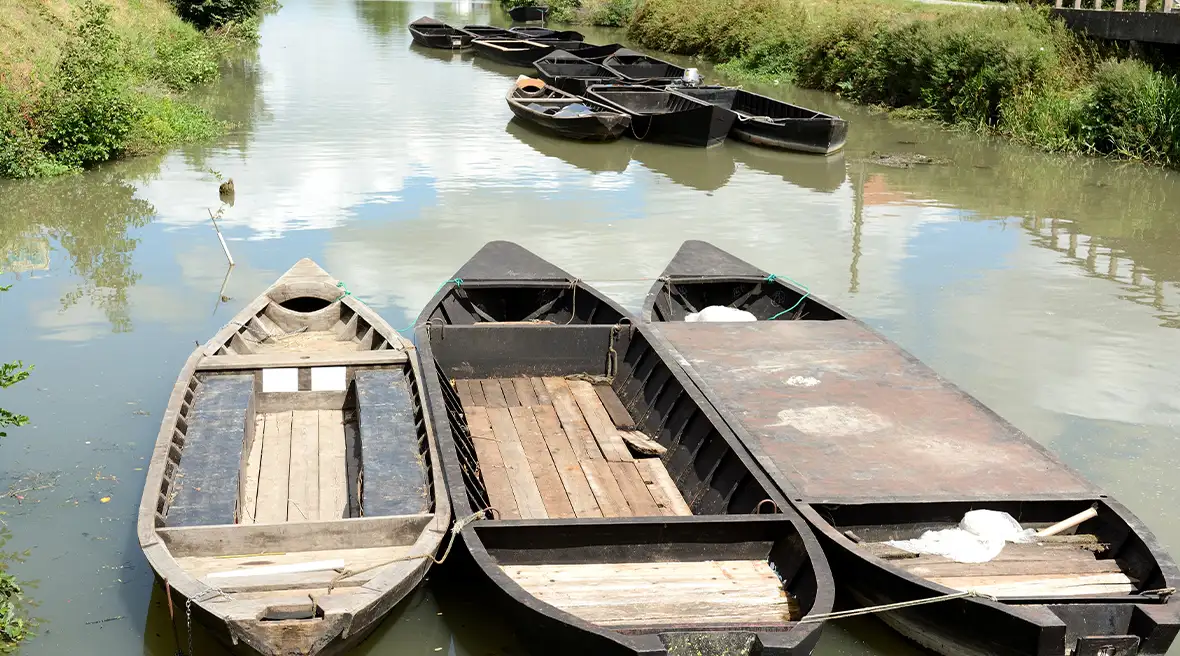 Row a bacôve on the Audomarois marshes
Visit La Coupole, a major V-2 rocket history site
It’s no coincidence that there is another V-2 bunker just a short distance from Blockhaus d’Éperlecques. The Nazis chose this region of Hauts-de-France as a V-2 launching area because it was within range of London, the missile’s primary target. La Coupole is a concrete dome half buried in the landscape, but the museum inside gives visitors an understanding of the events that shaped its history, as well as a programme of temporary exhibitions.
Explore the historic sights of Saint-Omer
The town of Saint-Omer is renowned for its medieval architecture, network of wetlands, its wartime heritage and thriving food and drink scene. Make sure you visit the Gothic cathedral, housing many treasures, and the evocative ruins of St Bertin abbey. You can also follow the trail dedicated to Douglas Bader, the RAF pilot shot down over Saint-Omer in 1941, and take a tour of the Brasserie Goudale, brewers of an award-winning local beer.
Discover the Audomarois marshes by boat or on foot
The town is at the heart of the Audomarois marshes, the only remaining cultivated wetlands in France. It is a pleasant walk along the many footpaths and trails, or take a flat-bottomed boat to explore more of the 4,000 hectares of waterways. These ‘bacôves’ can be hired for a few hours. Look out for the stalls on the banks where people sell fruit and vegetables grown in their riverside gardens.
Plan your visit to Blockhaus d’Éperlecques
 The bunker is an eerie, compelling place to visit (Image credit: Jean-Christophe BENOIST, CC BY-SA 4.0, via Wikimedia Commons)
Opening times, tickets and parking
The bunker is only fully open from April to October, and completely closed from November to February. There is limited weekend opening in March. In April, May, June and September the museum is open from 11am to 5.30pm. During July and August, Blockhaus d’Éperlecques is open from 10am to 6.30pm. The last admission is 1 hour 45 minutes before the site closes.
Tickets are €11.50 for adults and €6.50 for children, and are only available on the day. Parking is available at the large area in front of the main reception and shop.
How far is Blockhaus d’Éperlecques from Calais?
The Blockhaus d’Éperlecques museum is just a 35 minute drive from the LeShuttle terminal at Calais. Follow signs for Saint-Omer on the A26 autoroute, then for Watten on the D943 rural road.
Is Blockhaus d’Éperlecques suitable for families?
Yes. The site puts the bunker into the context of the war, highlighting the experiences of the people who were forced to build it. Some aspects of the museum are uncomfortable (like the cattle truck) but should not be overwhelming for older children and teenagers. Overall it is a powerful experience which should stay in the memories of people who visit.
How long do you need to visit Blockhaus d’Éperlecques?
1 hour 45 minutes is recommended as enough time to walk the nature trail and see inside the bunker.
Book a day trip to Blockhaus d’Éperlecques with LeShuttle
You don’t have to be a fan of military history to appreciate a visit to this relic of World War II. Blockhaus d’Éperlecques is a site which the whole family can get something from, and it’s just a short drive from the LeShuttle terminal.
Explore traveller guides


