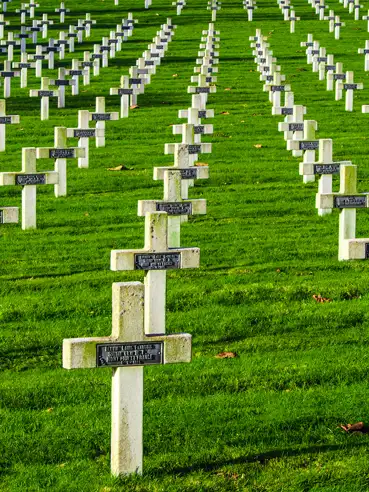
Remembrance Day in France

France feels the losses of the First World War especially deeply. That gives its Remembrance Day events even greater resonance.
Remembrance Day is a national holiday in France. There are events held across the country, to remember all French servicemen and women lost in conflicts.
What is Remembrance Day in France?
Remembrance Day (Jour d’Armistice) is a national day of remembrance in France held on 11th November each year. It marks the day when the armistice was signed at Compiègne in 1918, at the 11th hour, on the 11th day, on the 11th month, and the guns finally fell silent. While Armistice Day is marked throughout Europe and the Commonwealth, it has a particular poignancy in France, which experienced huge losses during the First World War. The battlefields of the Western Front saw towns and villages devastated. 1.4 million French soldiers died, and it is thought two in every three families lost a close family member.
 People gather at war memorials in towns and villages on Remembrance Day
How is Remembrance Day observed in France?
The symbol of Remembrance Day in France is Le Bluet – the blue cornflower that grew in fields where French soldiers fought and died in Flanders and the Somme during the First World War. Like the poppy in the UK, sales of the flower raises money for charity and it is worn by people in the lead up to Remembrance Day and at events on the day itself.
There is a national two minute silence at 11am, followed by church services, wreath-laying and acts of commemoration at war memorials in cities, towns and villages throughout France. At large city events there may be military parades of veterans and gun salutes. The names of the fallen are read out, with each given the honour ‘Mort pour la France’ – meaning they ‘died for France’.
Key memorial locations in France
Arc de Triomphe
 The Arc de Triomphe is the focus of national events on Remembrance Day in France
The national ceremony of remembrance takes place at the Arc de Triomphe in Paris, attended by the President of France and other major public figures. Wreaths are laid at the Tomb of the Unknown Soldier, which has been interred at the Arc de Triomphe for over a hundred years, and where an eternal flame has been continuously alight since 1923.
The wreath laying is followed by a military parade down the Champs-Élysées, and also includes gun salutes and ceremonial music. A church service in Notre Dame cathedral is led by the Royal British Legion and attended by veterans and military representatives from around the world.
Somme memorials
There are memorials across the Somme region to those who fell during the Battle of the Somme from 1916-18. These include the Lochnager Crater, the Ulster Tower Memorial and the Newfoundland Memorial. Remembrance Day events focus on the Thiepval Memorial to the Missing, which commemorates the 73,000 British and South African soldiers who died during the First World War with no known grave.
The Royal British Legion holds a Service of Remembrance at Thiepval on 11th November, attended by veterans, their representatives and the general public.
Verdun memorial
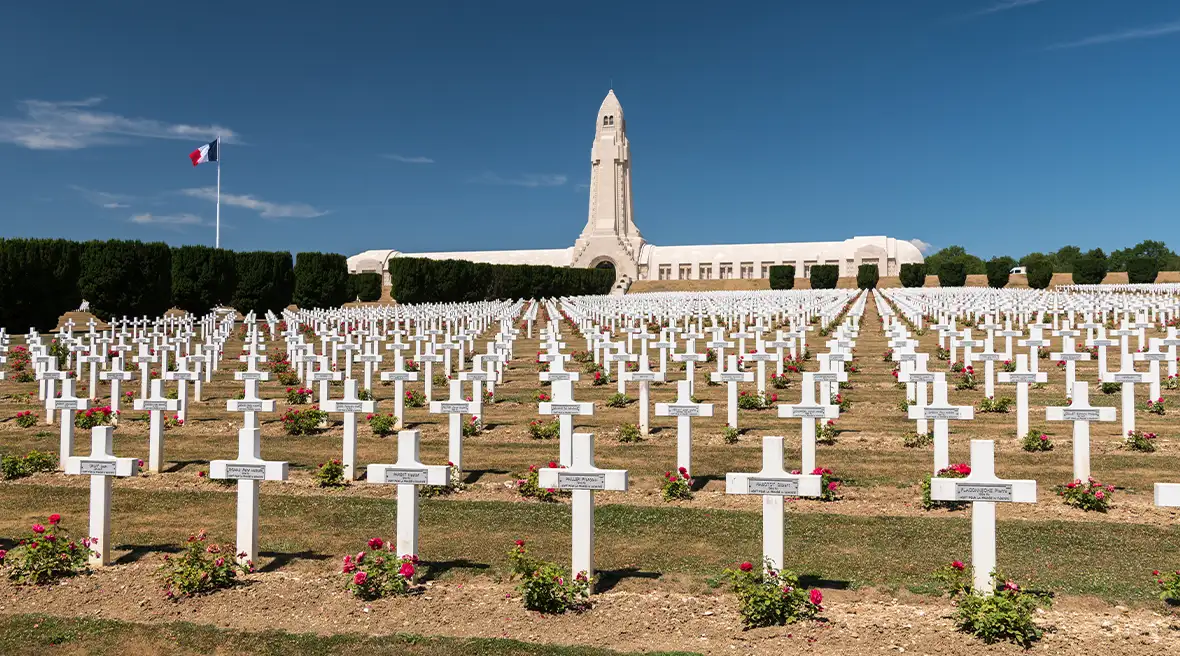 The military cemetery and Douaumont Ossuary, Verdun
The Battle of Verdun was the longest and bloodiest of the First World War, lasting from February to December 1916, and claiming 230,000 lives, mainly French and German. There are three main sites at Verdun today, the Douaumont Ossuary, Verdun Memorial and Verdun Victory Monument. The Ossuary is an incredibly striking sight, notable for its huge sandstone tower and its 42 alcoves, containing the bones of 130,000 unidentified soldiers killed during the battle. There have been Remembrance Day events held at all three sites.
Other days of military commemoration in France
France marks the end of the Second World War in Europe on May 8th each year – it is a national holiday, and is called ‘National Day’ in France. Again, events take place at the Arc de Triomphe and locally, featuring municipal parades. While more celebratory than Remembrance Day, National Day is still a time for sombre reflection and tribute.
July 1st, the anniversary of the opening day of the Battle of the Somme, is also remembered with services and vigils at the major Somme memorials – Thiepval, Lochnager and Ulster Tower.
Planning your visit to France for Remembrance Day
 The blue cornflower is the French symbol of Remembrance Day
Driving to memorial sites in France
The Somme battlefields are all within easy driving distance from the LeShuttle terminal at Calais. For example, driving to the Thiepval Memorial takes 1 hour 40 minutes. Driving to Paris for the Arc de Triomphe events is a 3 ½ hour trip from Calais. Driving to Verdun, near Reims, is around a four hour drive.
When is Remembrance day?
Remembrance Day in France is held on November 11th.
Is Remembrance day a public holiday in France?
Yes, Remembrance Day is a national holiday in France.
Can tourists attend Remembrance day events in France?
Yes, the general public are allowed to attend, but strict crowd control will be in place at the major events.
Are shops open on 11 November in France?
Banks, businesses and post offices are generally closed on November 11th. Some restaurants and cafes in large cities and popular tourist areas may be open, and shops are usually open but with reduced or Sunday trading hours. Public transport does run on Remembrance Day.
Visit France for Remembrance Day
Whether you have a family connection to the battlefield sites or not, visiting France for the Remembrance Day events is a poignant and moving experience. LeShuttle can help get you there, with 35-minute crossings from Folkestone to Calais.
Explore traveller guides


