Remembrance at the Menin Gate

Image credit: Gerardusanna, CC BY-SA 4.0, via Wikimedia Commons
Visit Ypres in Belgium and attend The Last Post, a solemn act of remembrance held every day to remember those who fell in Flanders during the First World War.
Every day at 8pm, the town of Ypres falls silent. Whether you have a relative who is commemorated at the Menin Gate memorial, or if you just want to pay tribute to those who made the ultimate sacrifice, taking part in the Last Post ceremony is an incredibly moving experience.
What is the Menin Gate Memorial to the Missing and why is it significant?
The Menin Gate Memorial in Ypres is a monumental stone triumphal arch that lists the names of over 54,000 Commonwealth soldiers who died in the Ypres Salient from 1914-1917, and whom have no known grave. It was designed by Reginald Blomfield and features over 1,000 inscription panels in Portland stone. The memorial has been extensively restored ahead of its 100th anniversary in 2027. It is one of a series of memorials across the Flanders region, but the Menin Gate has become particularly significant because of the Last Post ceremony, held daily at the memorial as a tribute to the courage of the men whose names are inscribed here.
The Last Post ceremony at the Menin Gate
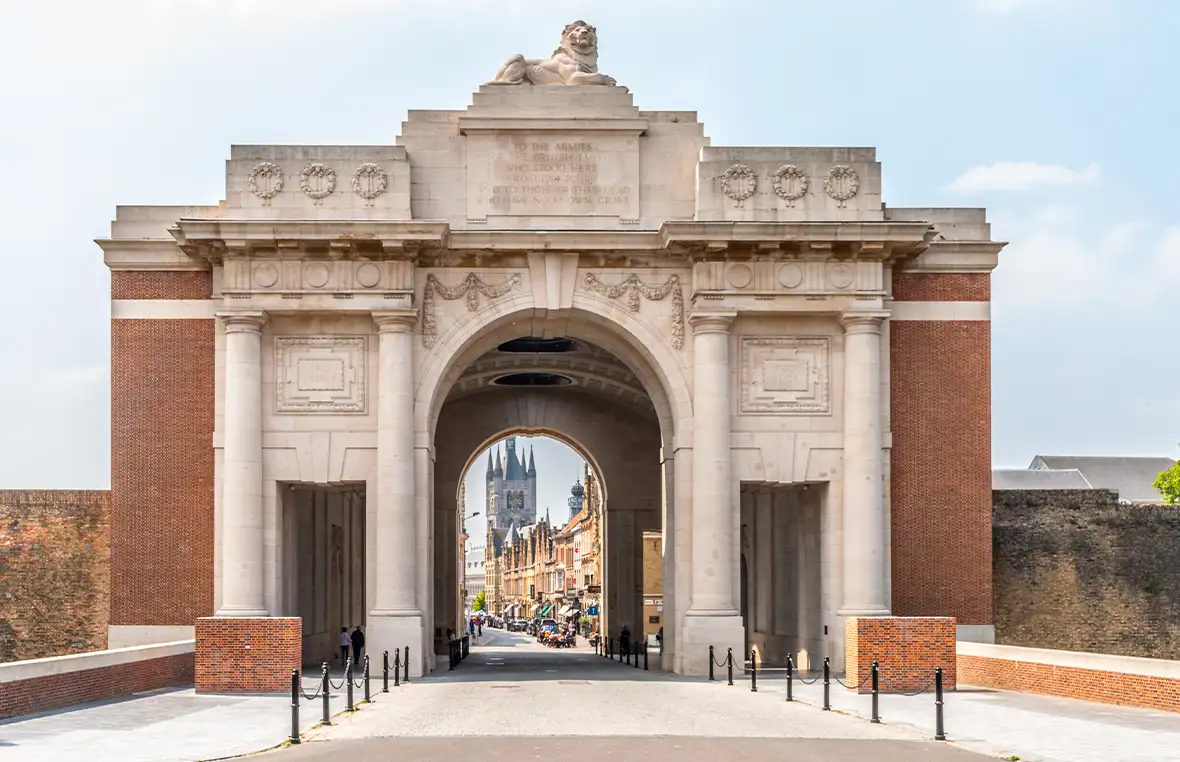 The Menin Gate, Ypres
What time is the Last Post ceremony at the Menin Gate?
The Last Post takes place at 8pm, every night at the Menin Gate.
What happens during the Last Post ceremony?
Traffic is stopped on the road through the gateway at 7.30pm. At 8pm buglers from the Last Post Association play the 75-second ‘Last Post’, a traditional military bugle call that has become a daily act of homage and remembrance. The Last Post is followed by a minute’s silence, and playing of the Réveille. Longer ceremonies may include music performed by bands and choirs, wreath laying and speeches by invited guests.
How to attend the ceremony respectfully
Anyone can attend the daily ceremony, but crowds often build up under the memorial arch, and behind the barriers either side of the monument. Visitors should remain silent throughout the ceremony.
Plan a visit to the Menin Gate in Ypres
 Personal tributes can be laid at the Menin Gate memorial
Where is the Menin Gate?
The Menin Gate is at the eastern end of the city centre in Ypres.
Can you visit the Menin Gate on a day trip from Calais?
Yes, Ypres is only a drive of around 1 hour 10 minutes from the LeShuttle terminal at Calais. If you want to attend the Last Post ceremony, it can be done in a day trip, but would mean a late return crossing home. Travelling on a Day Trip & Overnight ticket means you can include an overnight stay and return to the UK the following day.
How to find names on the Menin Gate?
 The names are grouped under their regiment
If you have a family connection to a name inscribed on the Menin Gate memorial, it is a good idea to do some research before visiting Ypres. The best way to do this is by searching the database on the Commonwealth War Graves Commission website. There are also alphabetical registers at the western entrance to the Memorial.
Where do you park for the Menin Gate?
The best place to park is at the Grote Markt in the town, near the Cloth Hall. It’s about a 5 minute walk away. Parking is free here after 6pm.
Accessibility and practical information for visitors
People usually stand to watch the ceremony, and chairs are not provided. There is a reserved area for wheelchair users, and the flat surface at floor level is accessible.
Visiting Ypres and the First World War sites
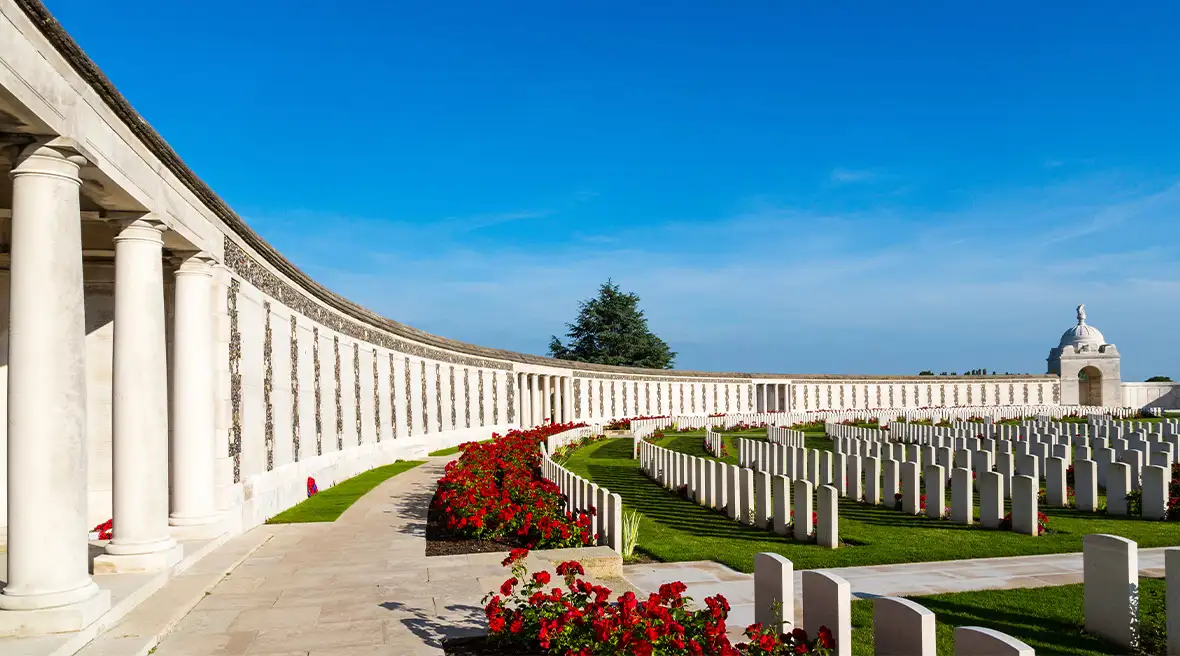 Tyne Cot memorial and cemetery
Explore Ypres Salient memorials
The Menin Gate has such resonance because Ypres was the city that was virtually destroyed by World War I and the intense fighting in the Ypres Salient. Allied soldiers would travel to the frontline along the same road that the memorial now stands above, many never to return.
Memorials are scattered across the former battlefields to the immediate north and east. Tyne Cot Memorial remembers the 35,000 men who fell in the area after 15 August 1917, with no known grave. The striking Saint Julien Memorial, 5 miles from Ypres, is a tribute to the Canadian troops who were lost during the 2nd Battle of Ypres in 1915, when poison gas was used on the Western Front for the first time. It is called ‘The Brooding Soldier’, and stands out amid the flat landscape.
Visit Tyne Cot Cemetery
Tyne Cot Cemetery is the largest Commonwealth War Graves cemetery, with nearly 12,000 burials. Most of the soldiers commemorated at Tyne Cot died during the Battle of Passchendaele in 1917-18. The cemetery was started during the battle itself, in a crater that served as a makeshift dressing station. It was vastly expanded after the end of the war, and now the headstones movingly extend, row after countless row, in this now peaceful plain.
Discover the In Flanders Fields Museum
The Cloth Hall is the enduring symbol of the carnage that was wrought on Ypres. Left in ruins by 1918, it was steadily rebuilt but not completely finished until the 1960s. It is now the home of the In Flanders Fields museum. The museum tells the powerful story of what happened in Ypres and Belgium during World War I, through audio-visual elements, archive footage, photography and original items and artefacts.
Pay your respects at the Menin Gate
For anyone interested in military history, or with a family connection to the First World War, visiting this part of Belgium and northern France should include the Menin Gate. The quickest way to get there is with a 35-minute LeShuttle crossing from Folkestone to Calais.
FAQs
Is the Last Post ceremony free to attend?
Yes, the Last Post ceremony is free to attend.
How long does a visit to the Menin Gate take?
Most days feature the simple Last Post ceremony, taking 5-10 minutes. Longer ceremonies, including wreath-laying and attendance from military regiments and veterans groups, may take up to 25 minutes.
Explore traveller guides