
French Christmas traditions

The food, the presents, the shoes ... find out everything you need to know about how Christmas is celebrated in France.
Christmas in France is in many respects similar to how we celebrate in the UK. There are some notable differences, which we shall explain more about in this guide to French Christmas traditions.
How Christmas in France is celebrated
The decorations, the Christmas tree, advent calendars, the food, the shopping, the family celebrations – if you happen to spend the festive season in France you will feel very much at home. But not everything is the same!
The top 5 things that makes a French Christmas different
• Children leave out shoes, not stockings, for Père Noël (Father Christmas)
• Some families expect Père Noël to deliver gifts on December 6th
• Presents are opened on Christmas Eve
• The Christmas Eve dinner is the main festive meal
• Boxing Day does not exist!
Yes, there is no equivalent to Boxing Day in France. The day after Christmas is a normal working day, and people are often back at work. The only areas of France where this is not the case is the Alsace and the Moselle region, which observes Saint Stephen’s Day on December 26th.
 Everyone gets together for the réveillon meal on Christmas Eve
French Christmas traditions
How Christmas Eve is celebrated
French households make a big thing of Christmas Eve. It is the day most children leave out shoes for Père Noël to fill with presents, and the night families have their réveillon – a marathon meal that lasts for several hours and sometimes is still going after Midnight Mass! People often open their presents on Christmas Eve rather than Christmas Day, but children usually have to wait until after midnight or the following morning to open what Père Noël has left them.
Père Noël
 Père Noël (Father Christmas) is as familiar a figure in France as in the UK
The figure of Father Christmas is called Père Noël in French. There is not much difference in how Père Noël looks, and he makes the same appearances at Christmas markets and shopping centres in the festive season. One major difference is that any child who writes to Père Noël in France always receives a reply, in the form of a postcard. It’s actually part of French law! Père Noël also prefers a glass of wine or Calvados to sherry! He delivers gifts on two days – December 6th and December 24th, depending on where you live in France.
St. Nicholas Day and Père Fouettard
There is an old folklore story told in France about three little children who get lost and captured by a wicked butcher, Père Fouettard. Fortunately for the kids, St Nicholas rescues them, which is how he became the patron saint of children. And so, in some parts of France, every year on the night before the 6th December, children leave out a boot or a shoe for St Nicholas who gives out gifts, sweets and gingerbread to all the good children, and Père Fouettard leaves the naughty ones lumps of coal.
Leaving shoes instead of stockings
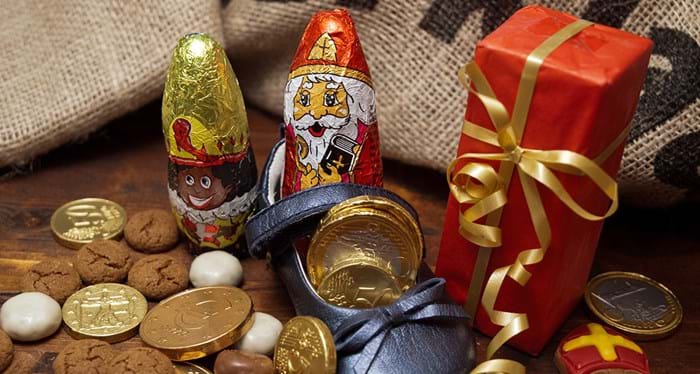 French children leave shoes out for Père Noël on Christmas Eve
In France children leave out shoes or wooden clogs for Père Noël rather than stockings. Both traditions come from the same Christian legend. Saint Nicholas of Myra threw gold coins through the window or down the chimney of a family in need. They landed in the family’s shoes or stockings, and so this is why shoes or stockings are put out on the eve of St Nicholas Day or Christmas Eve. It also helps to explain why chocolate coins wrapped in gold foil have always been traditional shoe (as opposed to stocking) fillers.
Carol singing and festive decorations
Carols are sung at church services, public events and family gatherings in France, and there are many popular French carols, such as ‘Douce Nuit’ and ‘Entre le bœuf et l’âne gris’, as well as French language versions of classic carols. People decorate their homes with real or artificial Christmas trees, hang wreaths or mistletoe on their front doors and have wooden nativity scenes (‘Crèche’) in their living rooms.
Regional customs and local variations
There are some fascinating Christmas traditions in different parts of France. For example, in the Alsace Saint Nicholas is often seen with a donkey, delivering gifts on December 6th. In Breton they serve buckwheat cakes with sour cream as part of the Christmas meal, and in Provence 13 different desserts are laid on the table on Christmas Eve and remain there for three days (more on that particular tradition later).
Christmas markets
 Colmar’s Christmas market is like a festive fairytale
All throughout France (and Europe) towns and cities host Christmas markets throughout December, with chalets selling gifts, local produce, hand-made decorations, food and drink. Buildings are lit up after dark and the bigger markets have ice skating rinks, ferris wheels, music and festive entertainment. Some of the most renowned Christmas markets in France are those held in Strasbourg, Colmar and Metz.
French Christmas food and special dishes
Christmas Eve dinner (Réveillon)
The prevailing tradition in France is for everyone to sit down together and feast on the 24th December for a long, often luxurious meal called the réveillon. This tends to start in the evening, sometimes following a day of fasting, and goes on until midnight and beyond. As well as turkey served with chestnuts, you may also find lobster, snails, and oysters on the table, and for dessert, a Bûche de Noël, which is a chocolate yule log.
All of this rich food is accompanied by fine wines and champagne for that little extra indulgence, and it’s traditional to sing carols and songs around the table. As you can imagine, Christmas dinner is a lively, merry affair in France!
 Roast turkey is still the most popular dish at a French Christmas dinner
Traditional dishes and desserts
Another festive cake eaten in France is the galette des rois, or cake of kings, which is particularly enjoyed at Epiphany on 6th January, the end of the traditional Christmas season. Made of puff pastry filled with frangipane or apples, a small porcelain charm or bean called a fève is hidden somewhere inside, and if you find it in your slice you are crowned king or queen for the day!
The 13 Desserts of Provence
In Provence, there is a delicious tradition of 13 desserts served at Christmas dinner, which represent Jesus and the 12 disciples. There is usually a mix of figs and dried fruit, sweet treats with walnuts, almonds, nougats and candies as well as a traditional cake called pompe à l’huile, which is bread-like in texture, and made with olive oil and flavoured with orange blossom.
Have a ‘Joyeux Noël’ with LeShuttle
What could be more festive than taking Le Sleigh (ok, LeShuttle) to France and celebrating Christmas there? It’s only a 35-minute crossing from Folkestone to Calais, and with no extra charges on baggage, you can pack as many presents as you can into the car!
Book your next adventure
Explore traveller guides


