
The châteaux and castles of the Loire Valley

See history come alive in the breathtaking castles of the Loire.
A road trip through the Loire Valley takes in many magnificent castles in idyllic locations.
Why visit Loire Valley castles and châteaux?
There are over 300 castles in the Loire Valley, one of France’s most beautiful regions. While most were built initially as fortresses, ultimately they became pleasure palaces and status symbols of French royalty and aristocracy. Some of the most famous castles in fiction and fairy tales have been inspired by châteaux in the Loire, and they all have fascinating stories of their own to tell.
All these castles, houses and palaces are within a short distance of each other in the Central Loire Valley, around 300 miles and a 5 hour drive from the LeShuttle terminal in Calais (although some will be a little closer and a little farther away). The cities of Angers, Blois and Tours are all ideal stops on a castle-themed road trip.
Best châteaux in the Loire Valley
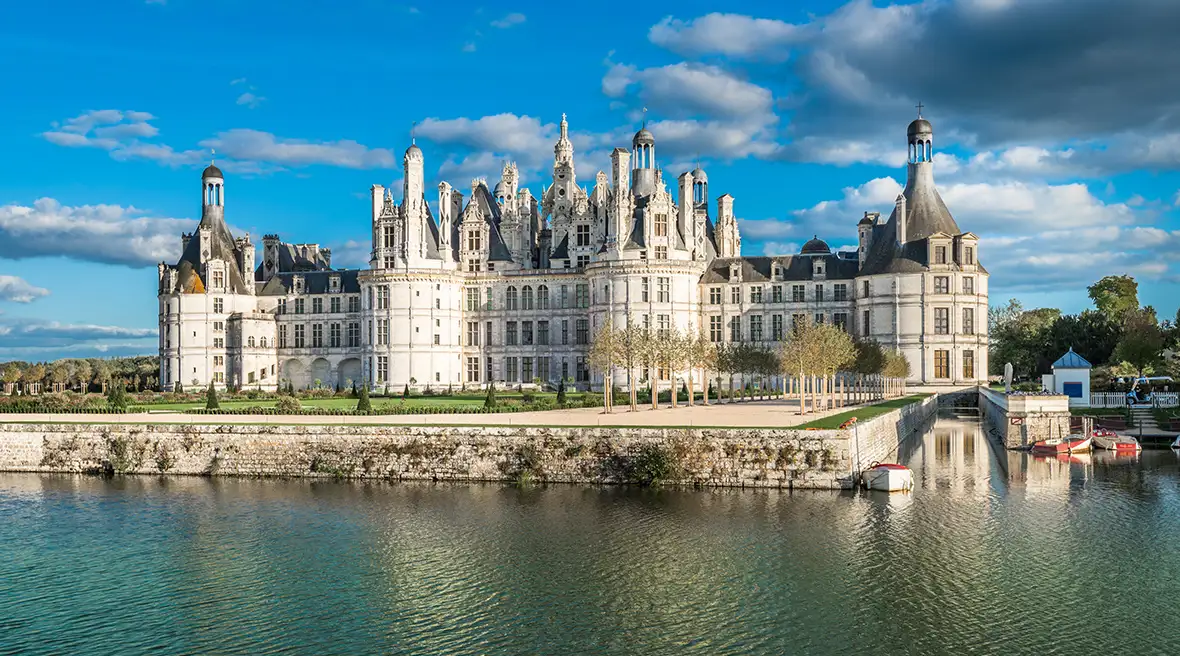 The sprawling giant of Château de Chambord
Château de Chambord – sublime Renaissance splendour
Where in France: Loire-et-Cher, Centre-Val de Loire
Distance from Calais: 288 miles / 4 hours 40 mins
How far from nearest city?: 23 minutes drive from Blois
If you see only one châteaux in the Loire Valley, make it Chambord. The novelist Victor Hugo said of it: “All magic … all madness is represented in the bizarreness of this palace of fairy kings and queens”. Château de Chambord has 441 rooms, 282 fireplaces, 84 staircases and a decorative moat, and was created by the French king Francis I as a symbol of royal power and splendour. What an impact this sprawling architectural masterpiece must have had in the mid-16th century on those who saw it, and the magnificent palace still dazzles today.
The facade looks almost like a city skyline, with turrets, spires and towers, and it is widely believed that Leonardo Da Vinci designed the central double helix staircase. Remarkably, it was built as a hunting lodge, and originally unfurnished. Visitors can explore lavish rooms like Francis I’s bedchamber and the Hall of the Illustrious, and the formal gardens, lawns and 13,000 acres of parkland that surround the chateau. Château de Chambord is open all year round, with guided tours in English available in July and August.
Château de Chenonceau - the ‘Ladies Castle’ on the Loire
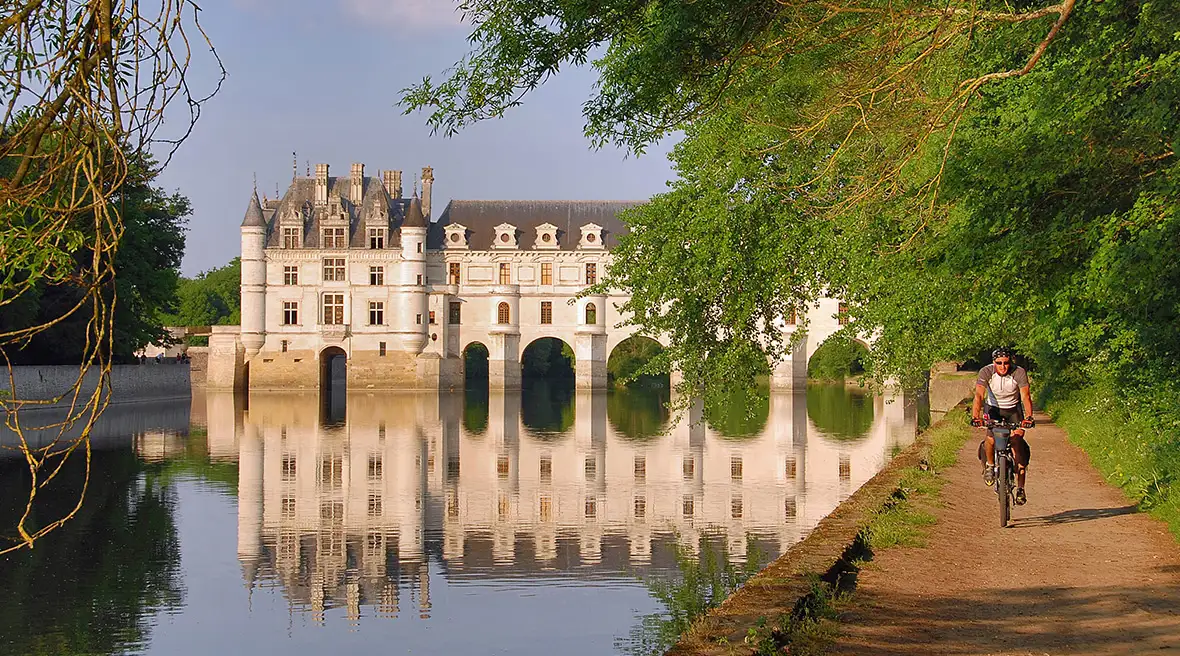 Château de Chenonceau
Where in France: Indre-et-Loire, Centre-Val de Loire
Distance from Calais: 321 miles / 5 hours 15 mins
How far from nearest city?: 38 minutes drive from Tours
Half house, half bridge, Château de Chenonceau is another spectacular example of a château from the Renaissance era. Known as the ‘Ladies Castle’ because of the long line of women who helped design and develop it, Château de Chenonceau changed hands many times, but usually within some of France’s most powerful and fashionable women, including Catherine de’ Medici, Regent of France, and Louise Dupin, who turned the castle into a literary salon. The inspired decision by one of its first owners to build an arched bridge from the island castle, and extend the interior of the castle across it, has made Château de Chenonceau the most visited palace in France after Versailles.
Visitors flock to see the fairytale setting of the castle, reflected in the waters of the river Cher, to admire the gallery over the bridge, and the gardens where Catherine de’ Medici staged the first ever fireworks display in France, in 1560. Tickets to visit the castle and gardens cost €19 for adults and €15 for children.
Château d’Amboise - Leonardo’s last resting place
Where in France: Indre-et-Loire, Centre-Val de Loire
Distance from Calais: 318 miles / 5 hours 10 mins
How far from nearest city?: 30 minutes drive from Tours
Royal and artistic connections make Château d’Amboise another ‘must visit’. Leonardo Da Vinci is buried in the palace chapel, and the castle was a hotbed of intrigue and conspiracy through its history.
Located on the banks of the Loire itself, the castle always had a defensive purpose, but was turned into a stylish Italianate palace in the late 15th century by the French king Charles VIII. It was under his son Francis I that Château d’Amboise enjoyed its golden age, when Leonardo Da Vinci was employed by the King and lived at Chateau du Clos Lucé, a smaller house nearby. These were some of the Italian artist’s happiest years, and he had no wish to see his homeland again. His tomb is in the Chapel of Saint Hubert, which rises high from the grounds of the Château over the small town of Amboise. In the 1560s a conspiracy against the Crown was discovered and over a thousand people were executed here and hung from the town walls, forcing the Court to abandon the castle. It’s hard to imagine now, as this castle is one of the loveliest on the Loire!
Château de Villandry – glorious formal gardens
 The glorious gardens of Villandry
Where in France: Indre-et-Loire, Centre-Val de Loire
Drive from Calais: 340 miles / 5 hours 30 mins
How far from nearest city?: 25 minutes drive from Tours
In some cases, as with the Château de Villandry, it is not the house but the gardens that do the talking. And in this case in particular, they talk very loudly indeed! Aside from the Palace of Versailles, the gardens at the Château de Villandry are some of the finest examples of French formal gardens in France, the beauty of which is achieved in the symmetry and order over nature.
Over the course of history, the gardens of the Château de Villandry have been chopped and changed, and fallen into various states of disrepair. It wasn’t until 1906 when Joachim Carvallo purchased the property and poured vast amounts of energy and money that they were restored to their former Renaissance glory. Amongst the formal gardens, you’ll find a water garden and a vegetable garden, as well as the ornamental flower gardens, all laid out in formal patterns marked out by low box hedges. Both the château and gardens are open to the public.
Château d’Azay-le-Rideau – an island fairytale
 The idyllic island Château d’Azay-le-Rideau
Where in France: Indre-et-Loire, Centre-Val de Loire
Drive from Calais: 338 miles / 5 hours 30 mins
How far from nearest city?: 25 minutes drive from Tours
Built on an island, you could be forgiven for thinking Château d’Azay-le-Rideau is not real at all – so perfect and dreamlike does it appear to be. The French writer Honoré de Balzac said the château was like “a faceted diamond set in the Indre bathing in the river like a princely creature”. Again dating from the early 16th century, the castle is crowned with some dazzling architectural features, such as the grand stone staircase and the Salon Biencourt, a lavishly decorated room with an incredible stone fireplace, tapestries and Renaissance artworks. The castle is one of the most popular in the Loire valley to visit, and during the high summer season an immersive historical theatrical show is staged, reflecting historical events that would have swirled around the Château d’Azay-le-Rideau.
In July and August the castle gates are open until 11pm each night. With the moonlight illuminating the castle walls, the scent of lavender heavy in the air and the dragonflies hovering over the water, this really does feel like a fairytale castle.
Château de Blois – one of France’s most historic buildings
Where in France: Loire-et-Cher, Centre-Val de Loire
Drive from Calais: 293 miles / 4 hours 50 mins
How far from nearest city?: The château is right in the centre of Blois
Château de Blois is not only one of the leading castles of the Loire, but one of the most important buildings in France. It was the favourite residence of seven French kings, and has seen major historical events. Joan of Arc was blessed at Château de Blois in 1429 before she led the relief of Orléans, and the King of France ruled from here for a while during the French Wars of Religion in the 16th century. The breathtaking Estates General Room in the château is where this sense of history is most palpable. Unlike many of the castles in the Loire, Blois is a massive building, with at least four distinct architectural periods. It is home to the Blois Museum of Fine Arts, and is even called the unofficial ‘Musee de France’ for the richness of its art collection. Every night between April and October, a Sound and Light show is projected onto the castle walls, telling the stories of its incredible history.
Hidden gems and lesser-known Loire Valley châteaux
 Cycling at Château de Montsoreau
Château d’Ussé
Drive from Calais: 343 miles / 5 hours 35 mins
How far from nearest city?: 45 minutes drive from Tours
As we’re exploring the land of real-life fairy tale castles, it seems fitting to include Château d'Ussé. It is this grand château that was the inspiration behind the enchanted castle in Charles Perrault’s Sleeping Beauty, as well as serving as inspiration for Walt Disney when he was creating his Disney Castles.
Sat happily at the edge of the Chinon forest, there has been a fortification of some nature on this site since the 11th century. The château fell into disrepair until the 15th century when it was purchased by a captain-general of Charles VII. Many alterations and restorations took place over the next two hundred years, resulting in the beautiful structure you see today.
Château d'Ussé is open to the public from February to November.
Château de Montsoreau
Drive from Calais: 335 miles / 5 hours 30 mins
How far from nearest city?: 50 minutes drive from Tours
The Château de Montsoreau is completely unique to the region in that it’s the only château built directly on the riverbed of the Loire. It’s located at the confluence of the Loire and the Vienne rivers, which is also the meeting point of the historic regions of Anjou, Poitou and Touraine.
The château is now a museum of contemporary art, and open to the public. It’s a privately run museum, founded by Philippe Méaille, French contemporary art collector and owner of the world’s largest collection of Art and Language works, which make up the permanent collection.
Château de Saumur
Drive from Calais: 330 miles / 5 hours 20 mins
How far from nearest city?: 50 minutes drive from Angers
Occupying a majestic position high above the Loire, the castle at Saumur has a long and turbulent history, and originally dates from the 10th century. Principally a fortress in the Middle Ages for the Dukes of Anjou, it was later turned into a palace, then a military barracks and even a prison under Napoleon Bonaparte. Its image was memorably captured in the famous medieval illuminated manuscript, the Très Riches Heures du Duc de Berry. The Château is now a museum, specialising in ceramics, decorative arts and equine heritage.
Plan a visit to the châteaux in the Loire Valley
 The majestic location of Château de Saumur
How to plan a Loire Valley château itinerary
You could easily spend a week or more touring the castles of the Loire Valley, combining it with vineyards too! One of the beauties of the Loire is that all of the châteaux are quite close to each other, and all the sites in our guide are located between the cities of Angers and Orléans, a route that can be driven in around 2 ½ hours. Here’s a sample itinerary if you wanted to visit all the châteaux featured above:
Day 1: Drive from Angers
- Château de Saumur
- Château de Montsoreau
- Château d’Ussé
- Château de Villandry
Overnight stay in Tours
Day 2: Drive from Tours
- Château d’Amboise
- Château d’Azay-le-Rideau
- Château de Chenonceau
Overnight stay in Blois
Day 3: Drive from Blois
- Château de Blois
- Château de Chambord
Best places to stay for Loire Valley castles
If you can afford it, then staying in an actual château could hardly be bettered. There are many châteaux that have been converted into hotels across the Loire, but room rates are high. A one night treat perhaps?
There are plenty of accommodation options in Angers, Tours, Blois and Orléans, as well as the picturesque towns and villages along the Loire valley, like Amboise and Chinon, from budget hotels to hostels, campsites to gîtes. You might even find some châteaux that offer camping areas, like Le Château de Chanteloup in the Pays de la Loire near Le Mans.
Family-friendly Loire Valley châteaux visits
Keeping the kids entertained as you tour the castles might sound like a challenge, but some of the bigger châteaux make a real effort to engage with children. At Châteaux de Cheverny near Blois there are LEGO replicas of the castle and furniture, a maze, and a Tintin exhibition – the castle was the inspiration for ‘Château de Marlinspike’ in the famous comic strip. Château du Clos Lucé, Leonardo Da Vinci’s home near Château d’Amboise, is also fascinating for children because of the playground featuring many of his machines and inventions.
Best time to visit the Loire Valley
Most people visit the Loire during the summer, but very hot weather in the region is not uncommon, and temperatures can easily reach 30-35 degrees at times. Avoiding the warmest months of June, July and August may be advisable, but these are also the months when many of the castles stage extra attractions. April, May and September may be a better time to travel.
Explore the Loire Valley’s most beautiful castles with LeShuttle
Discover the châteaux of the Loire and the astonishing beauty of the landscape that surrounds them with LeShuttle. The crossing from Folkestone to Calais takes just 35 minutes.
FAQs
How many days do you need to tour the Loire Valley castles?
You could easily spend a couple of weeks in the region just visiting châteaux, but equally you could see the best castles in a couple of days.
Where is the best place to stay for exploring the Loire chateaux?
The cities of Tours and Blois offer the best choice of accommodation, and are most convenient for visiting the best châteaux.
Can you visit Loire Valley châteaux with children?
Yes, many châteaux offer free admission for young children, and some cater for children with special themed attractions and play areas.


